Supply Chain · 14 min read · May 19, 2026
Supply Chain Data Analytics: How to Spot Inventory Problems Before They Hit Your P&L
From stockout prediction to supplier lead time variance, this guide covers the data signals that operations teams should monitor daily — and how to build an early warning system without an enterprise BI tool.
Supply Chain Data Analytics: How to Spot Inventory Problems Before They Hit Your P&L
Editor's note (July 2026): A year of watching operators use this playbook has only strengthened its core lesson: inventory surprises are almost never data problems — they are attention problems. The signal was usually sitting in the report two weeks before the stockout or the write-off; nobody had time to read it. That is why we now recommend pairing any supply-chain analytics stack with a daily plain-English digest rather than another dashboard: a short morning note that flags "sell-through on SKU-1842 dropped 31% week-over-week" gets acted on, while the same cell in a BI grid gets scrolled past. As you work through the frameworks below, ask of every metric not just "can we measure it?" but "who reads it, and when?" — that single question does more for inventory intelligence than any model upgrade. If you want to test the habit today, take last week's numbers and run them through our free 7-Day Projections Calculator: you will get next week's likely range — with an honest uncertainty band instead of false precision — in under a minute, no signup required. In today's dynamic business landscape, effective supply chain management is paramount to maintaining profitability and ensuring customer satisfaction. Businesses often grapple with the complexities of inventory, a critical asset that, if mismanaged, can quickly erode profit margins. The ability to anticipate and address inventory problems before they escalate into significant financial setbacks is a competitive advantage. This guide delves into the power of supply chain data analytics to transform reactive inventory management into a proactive, intelligent system, enabling organizations to identify potential issues and safeguard their bottom line.
In today's dynamic business landscape, effective supply chain management is paramount to maintaining profitability and ensuring customer satisfaction. Businesses often grapple with the complexities of inventory, a critical asset that, if mismanaged, can quickly erode profit margins. The ability to anticipate and address inventory problems before they escalate into significant financial setbacks is a competitive advantage. This guide delves into the power of supply chain data analytics to transform reactive inventory management into a proactive, intelligent system, enabling organizations to identify potential issues and safeguard their bottom line.
The Critical Role of Data in Modern Supply Chains
The modern supply chain generates an immense volume of data, from procurement and production to logistics and sales. This data, when properly analyzed, offers invaluable insights into operational efficiencies, potential bottlenecks, and emerging trends. Relying on intuition or outdated reports is no longer sufficient; a data-driven approach is essential for navigating the intricacies of global supply networks and optimizing performance. By harnessing the power of supply chain data analytics, businesses can move beyond historical reporting to predictive insights, fostering greater resilience and agility.
Beyond Traditional Inventory Management
Traditional inventory management often focuses on historical sales data and reorder points, which can be inherently reactive. While these methods have their place, they often fail to account for real-time fluctuations, external disruptions, or subtle shifts in demand. Inventory intelligence, powered by advanced analytics, transcends these limitations by integrating diverse data sources and applying sophisticated analytical techniques. This allows for a more holistic view of inventory health, enabling businesses to make informed decisions that minimize risk and maximize efficiency.
Key Data Signals for Proactive Inventory Intelligence
To effectively spot inventory problems, operations teams must monitor a range of data signals. These signals provide early indicators of potential issues, allowing for timely intervention. Understanding and tracking these metrics is fundamental to building a robust early warning system.
Stockout Prediction and Prevention
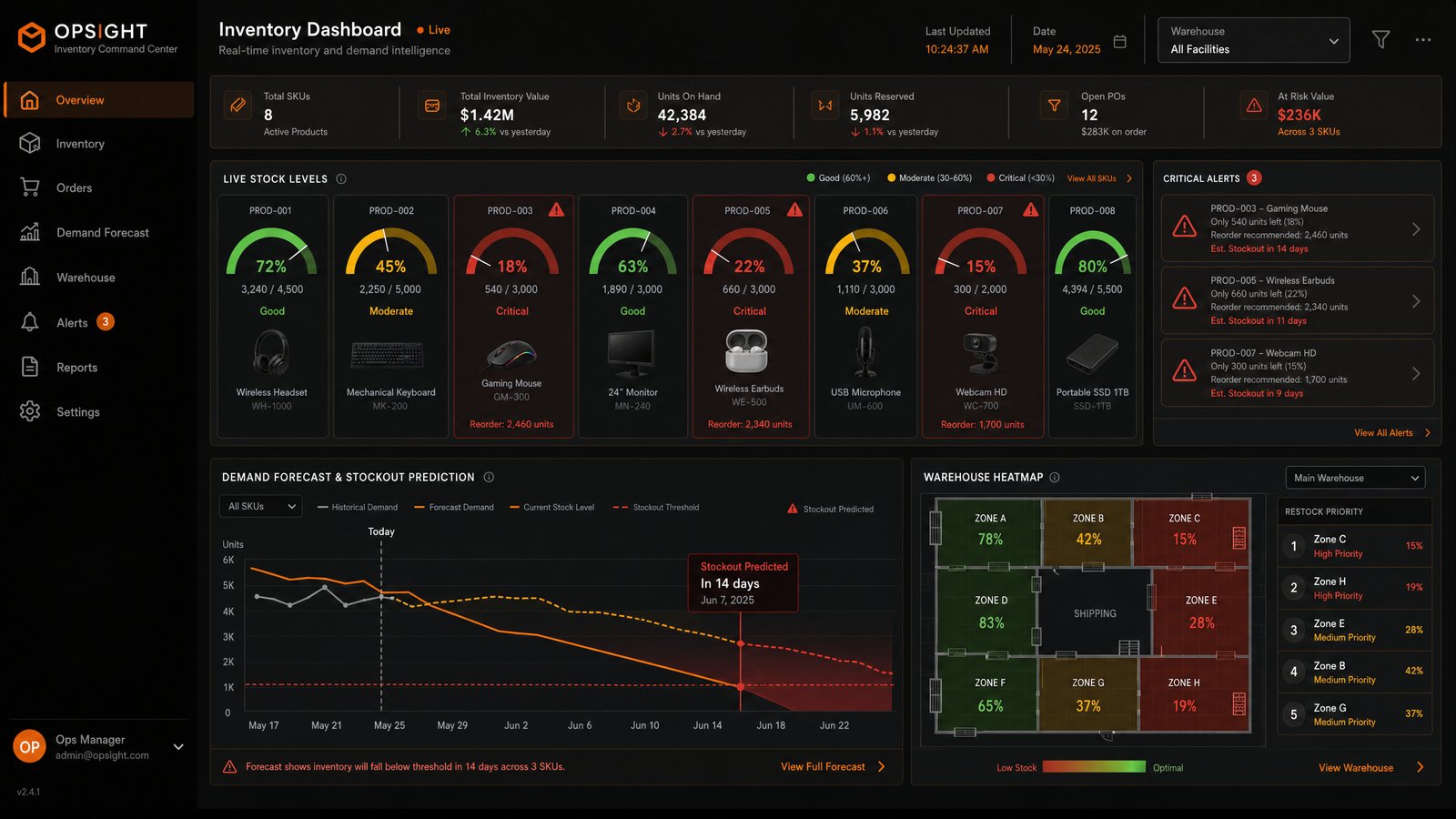
Stockouts are among the most damaging inventory problems, leading to lost sales, customer dissatisfaction, and potential brand damage. Proactive stockout prediction involves analyzing several data points:
- Sales Velocity: Tracking the rate at which products are sold provides a baseline for demand. Anomalies in sales velocity can signal impending stockouts or overstock situations.
- Current Inventory Levels: Real-time visibility into inventory counts across all locations is crucial. This includes raw materials, work-in-progress, and finished goods.
- Open Purchase Orders: Understanding incoming supply helps to balance current inventory with future demand.
- Supplier Performance Data: Delays from suppliers directly impact stock availability. Monitoring supplier lead times and reliability is key.
- Promotional Impact: Planned marketing campaigns or seasonal spikes can significantly alter demand patterns, requiring adjustments to inventory levels.
By integrating these data points, businesses can develop models that predict the likelihood of a stockout for specific products, enabling them to take preventative action such as expediting orders or reallocating stock.
Analyzing Supplier Lead Time Variance
Supplier lead time variance refers to the difference between expected and actual delivery times from suppliers. High variance can disrupt production schedules, lead to unexpected stockouts, or necessitate costly rush orders. Monitoring this metric involves:
- Historical Lead Time Data: Establishing a baseline for each supplier and product.
- On-Time Delivery Rates: Tracking the percentage of orders delivered within the agreed timeframe.
- Communication Logs: Analyzing communication with suppliers for early warnings of potential delays.
- Geopolitical and Environmental Factors: External events can significantly impact lead times, requiring continuous monitoring of global conditions.
Understanding and mitigating lead time variance is vital for maintaining a smooth flow of goods and preventing downstream inventory issues.
Demand Forecasting Accuracy
Accurate demand forecasting is the cornerstone of effective inventory management. Inaccurate forecasts can lead to either excessive inventory (tying up capital and incurring holding costs) or insufficient inventory (resulting in stockouts). Improving demand forecasting accuracy requires:
- Granular Sales Data: Analyzing sales at a product, regional, and even customer segment level.
- External Factors: Incorporating macroeconomic indicators, competitor activities, and market trends.
- Promotional Calendars: Accounting for the impact of planned sales and marketing activities.
- Feedback Loops: Continuously comparing forecasts against actual sales and adjusting models accordingly.
Leveraging advanced analytics can help identify patterns and correlations that improve the reliability of demand predictions, directly impacting inventory optimization.
Inventory Turnover and Holding Costs
Inventory turnover measures how many times inventory is sold or used over a period, indicating efficiency. High turnover is generally desirable, as it suggests efficient sales and minimal holding costs. Conversely, low turnover can signal obsolete stock or overstocking. Closely related are holding costs, which include expenses like warehousing, insurance, obsolescence, and capital tied up in inventory. Monitoring these metrics helps identify:
- Slow-Moving or Obsolete Inventory: Products that are not selling as expected, leading to increased holding costs and potential write-offs.
- Excess Inventory: Capital that could be better utilized elsewhere is tied up in surplus stock.
- Storage Inefficiencies: High holding costs might indicate a need to optimize warehouse space or logistics.
By analyzing turnover rates and associated costs, businesses can identify areas for inventory reduction and operational improvement, directly impacting their P&L.
Building an Early Warning System Without Enterprise BI
Many businesses, particularly small to medium-sized enterprises, may not have access to expensive enterprise Business Intelligence (BI) tools. However, this does not preclude them from building an effective early warning system for inventory problems. The key lies in leveraging existing resources and adopting a systematic approach to supply chain data analytics.
Leveraging Existing Data Sources
Most businesses already possess a wealth of data across various platforms. This includes:
- E-commerce Platforms: Shopify, WooCommerce, etc., provide sales, order, and customer data.
- Accounting Software: Stripe, QuickBooks, etc., offer financial transaction data.
- Marketing Platforms: Meta Ads, Mailchimp, Google Analytics 4 (GA4), etc., provide insights into demand generation.
- CRM/Helpdesk Systems: HubSpot, Zendesk, etc., contain customer interactions and feedback that can signal demand shifts.
The challenge is not a lack of data, but rather the ability to consolidate and analyze it effectively.
Simple Tools for Data Aggregation and Analysis
Even without a dedicated BI suite, businesses can implement robust data analytics. Spreadsheets, while basic, can be powerful when used systematically. Cloud-based tools and simple scripting can automate data extraction and basic analysis. The focus should be on creating dashboards that visualize key performance indicators (KPIs) identified earlier, such as stockout risk, lead time variance, and inventory turnover. Regular review of these dashboards can serve as a powerful early warning mechanism, enabling teams to spot trends and anomalies before they become critical issues.
The Impact of Proactive Inventory Management on Your P&L
Proactive inventory management, driven by sophisticated supply chain data analytics, has a direct and significant impact on a company's Profit and Loss (P&L) statement. By minimizing stockouts, businesses avoid lost sales and maintain customer loyalty. Optimizing inventory levels reduces holding costs, frees up working capital, and mitigates the risk of obsolescence. Furthermore, improved supplier relationships through better forecasting and communication can lead to more favorable terms and reduced procurement costs. Ultimately, an intelligent approach to inventory management translates into healthier cash flow, increased profitability, and a stronger competitive position.
In an increasingly complex global marketplace, the ability to anticipate and respond to inventory challenges is no longer a luxury but a necessity. Embracing supply chain data analytics empowers businesses to transform their operations, turning potential problems into opportunities for efficiency and growth.
Ready to transform your inventory management and gain unparalleled insights into your supply chain? Upload a CSV or Excel export from your ERP — SAP included — and discover how DawnPulse's AI-powered daily briefing can provide anomaly detection, trend analysis, and actionable recommendations to keep your business ahead of the curve. Start your 14-day free Pro trial today.