Technology · 11 min read · May 19, 2026
AI-Powered Business Intelligence vs Traditional BI Tools: What's Actually Different?
A clear-eyed comparison of AI-native analytics platforms against traditional BI tools like Tableau and Power BI — covering insight generation speed, technical requirements, and total cost of ownership.
AI-Powered Business Intelligence vs Traditional BI Tools: What's Actually Different?
In the rapidly evolving landscape of business analytics, organizations are constantly seeking more efficient and insightful ways to leverage their data. This pursuit often leads to a critical decision point: investing in AI-Powered Business Intelligence solutions or continuing with established Traditional BI Tools. While both aim to transform raw data into actionable insights, their methodologies, capabilities, and ultimate impact on decision-making processes diverge significantly. Understanding these fundamental differences is crucial for businesses looking to optimize their analytical infrastructure and gain a competitive edge in a data-driven world.
The Foundational Divide: Approach to Data Analysis
The core distinction between AI-Powered Business Intelligence and Traditional BI Tools lies in their approach to data analysis and insight generation. Traditional BI platforms, such as Tableau or Power BI, excel at data visualization, dashboard creation, and reporting based on predefined queries and models. They empower users to explore data, identify trends, and answer specific questions, but the onus of formulating those questions and interpreting the results largely falls on the human analyst. The insights derived are a direct result of the queries posed and the data models constructed by skilled professionals.
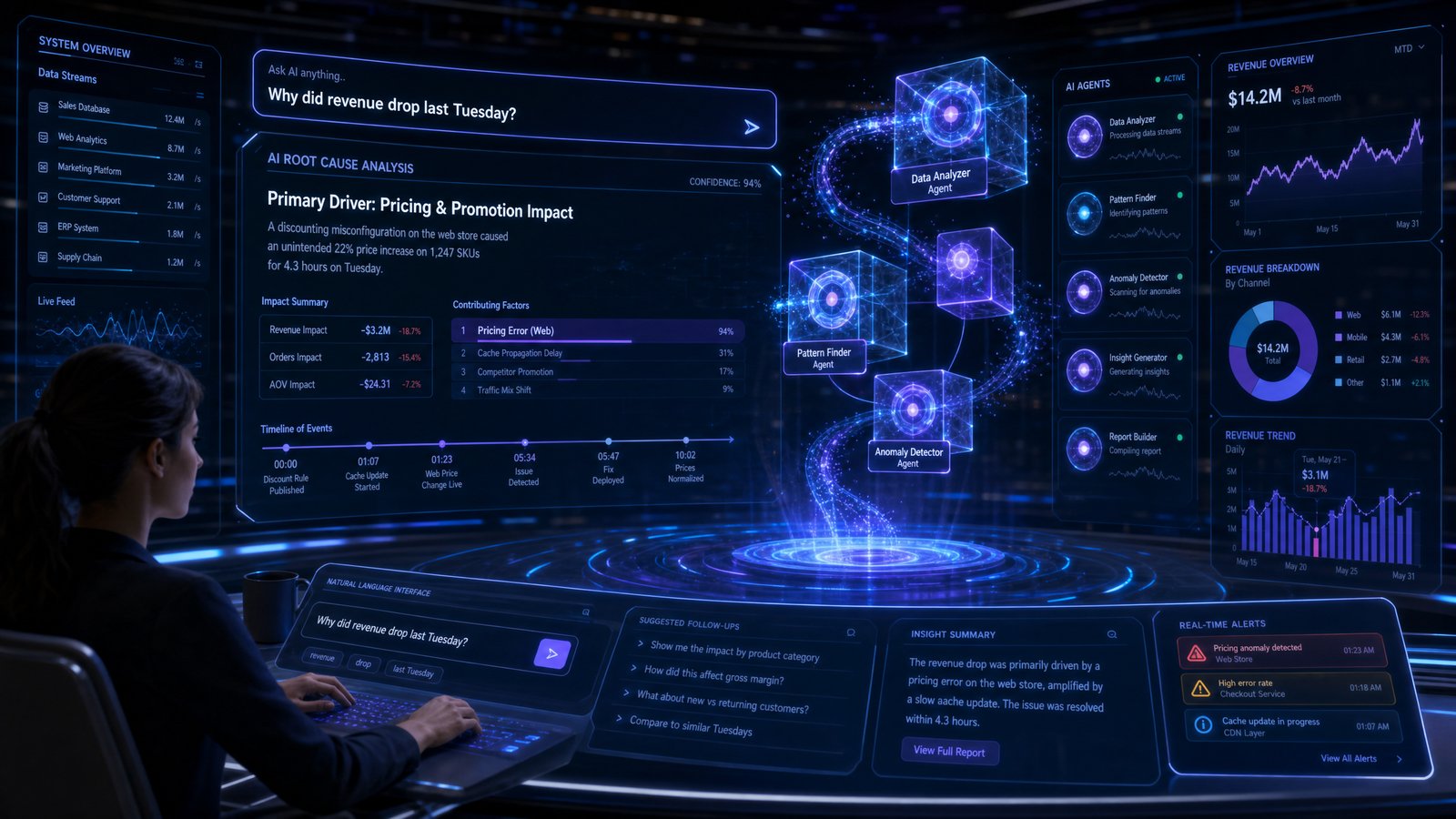
Conversely, AI-Powered Business Intelligence solutions integrate machine learning algorithms and artificial intelligence to automate and augment the analytical process. These tools go beyond merely presenting data; they actively analyze it, identify patterns, detect anomalies, and even generate predictive models without explicit human prompting for every query. This shift from reactive reporting to proactive insight generation fundamentally alters how businesses interact with their data, moving towards a more autonomous and intelligent analytical ecosystem.
Insight Generation Speed and Depth
One of the most compelling advantages of AI-Powered Business Intelligence is its unparalleled speed in generating insights. Traditional BI often requires a significant investment of time from data analysts to clean, transform, model, and visualize data before any meaningful conclusions can be drawn. This process can be iterative and time-consuming, especially when dealing with large, complex datasets or when new questions arise.
AI-driven platforms, however, can process vast quantities of data almost instantaneously, identifying subtle correlations and anomalies that might elude human analysts. They can continuously monitor data streams, providing real-time alerts and trend analysis as events unfold. This rapid insight generation means businesses can react more quickly to market changes, operational issues, or emerging opportunities, transforming data from a historical record into a dynamic strategic asset. The depth of analysis is also enhanced, as AI can uncover non-obvious relationships across disparate data sources, leading to more comprehensive and nuanced understandings.
Technical Requirements and User Accessibility
Traditional BI Tools typically demand a certain level of technical proficiency. Users often need to understand data warehousing concepts, SQL queries, and the intricacies of data modeling to effectively build reports and dashboards. While these tools offer powerful capabilities, their steep learning curve can limit their accessibility to a broader business audience, often confining advanced analysis to specialized data teams.
AI-Powered Business Intelligence aims to democratize data access and analysis. By automating many of the complex analytical tasks, these platforms reduce the technical barrier to entry. Business users, even those without extensive data science backgrounds, can leverage natural language queries or intuitive interfaces to ask complex questions and receive sophisticated answers. This increased accessibility empowers more employees across an organization to make data-informed decisions, fostering a truly data-driven culture. The focus shifts from how to analyze data to what insights are most relevant.
Total Cost of Ownership (TCO)
The Total Cost of Ownership (TCO) for BI solutions encompasses not just software licenses but also infrastructure, maintenance, training, and, critically, human capital. Traditional BI, while seemingly straightforward in its software costs, often incurs substantial ongoing expenses related to hiring and retaining skilled data analysts and developers to build and maintain reports, dashboards, and data pipelines. As data volumes grow and business questions evolve, these human resource costs can escalate.
AI-Powered Business Intelligence, while potentially having a higher initial investment in advanced algorithms and infrastructure, can offer a more favorable TCO in the long run. By automating repetitive analytical tasks and reducing the reliance on extensive human intervention for routine reporting and anomaly detection, these systems can free up valuable human resources to focus on higher-value strategic initiatives. The efficiency gained through automation can lead to significant operational savings and a higher return on investment over time, especially as the system learns and optimizes its performance.
Data Integration and Scope
Traditional BI platforms often thrive on structured data from well-defined sources like relational databases and enterprise resource planning (ERP) systems. Integrating diverse data types, such as unstructured text, social media feeds, or real-time streaming data, can be challenging and require extensive custom development or specialized connectors.
AI-Powered Business Intelligence solutions are inherently designed to handle a much broader scope of data. They excel at integrating and analyzing data from a multitude of sources, including CRM, marketing platforms, financial systems, and even external unstructured data. This capability allows for a more holistic view of business operations, enabling comprehensive trend analysis and anomaly detection across the entire data ecosystem. The ability to connect disparate data points provides a richer context for decision-making, moving beyond departmental silos.
Anomaly Detection and Predictive Capabilities
One of the standout features of AI-Powered Business Intelligence is its advanced anomaly detection and predictive capabilities. Traditional BI typically identifies anomalies by comparing current data against predefined thresholds or historical averages, which requires manual setup and constant adjustment. Predictive analysis in traditional BI often relies on statistical models built and maintained by data scientists.
AI-driven systems, conversely, use machine learning to automatically learn normal patterns in data. They can then flag deviations that indicate potential issues or opportunities, often before they become critical. This proactive anomaly detection is invaluable for identifying fraud, operational inefficiencies, or sudden shifts in customer behavior. Furthermore, AI can build sophisticated predictive models that forecast future trends, customer churn, or sales performance with greater accuracy and less manual effort, providing actionable recommendations for strategic planning.
Actionable Recommendations
Traditional BI primarily presents data and visualizations, leaving the interpretation and formulation of actions to the user. While powerful, this requires a human to bridge the gap between insight and action.
AI-Powered Business Intelligence takes this a step further by often providing direct, actionable recommendations. Based on its analysis, the AI can suggest specific steps to optimize marketing campaigns, improve supply chain efficiency, or enhance customer engagement. These recommendations are not just data points; they are prescriptive suggestions designed to drive tangible business outcomes. This capability transforms the BI tool from a reporting engine into a strategic advisor, offering concrete guidance derived from complex data analysis.
The Verdict: When to Choose Which
The choice between AI-Powered Business Intelligence and Traditional BI Tools is not always an either/or proposition; often, it's about understanding which solution best fits specific organizational needs and maturity levels. Traditional BI remains highly effective for organizations with well-structured data, clear reporting requirements, and established analytical teams. It provides robust capabilities for deep dives into specific questions and for creating customized dashboards that reflect known key performance indicators.
However, for businesses seeking to move beyond reactive reporting to proactive, predictive, and prescriptive analytics, AI-Powered Business Intelligence offers a transformative advantage. If your organization deals with vast, diverse, and rapidly changing datasets, requires automated anomaly detection, seeks actionable recommendations, and aims to democratize data insights across a broader user base, an AI-powered approach is the clear path forward. It's particularly beneficial for companies looking to optimize operations, enhance customer experiences, and uncover hidden opportunities through advanced trend analysis.
Conclusion
The evolution from traditional business intelligence to AI-Powered Business Intelligence marks a significant leap in how organizations harness their data. While traditional tools provide essential foundations for data understanding, AI-driven platforms offer a more dynamic, automated, and insightful approach, delivering faster insights, reducing technical barriers, and providing actionable recommendations. The future of business intelligence is undoubtedly intelligent, empowering businesses to not just see their data, but to truly understand and act upon it with unprecedented efficiency and foresight. To experience the power of AI-driven insights and transform your data into a strategic advantage, take the DawnPulse product tour — or start your 14-day free Pro trial today and get your first AI-powered daily briefing tomorrow morning. No credit card required.